M4Markets (m4markets.com) is a CFD trading platform that we feature alongside four competitors in this comparison of CFD brokers for index trading. The article is for readers who want to see how brokers differ on regulation, costs, leverage, platforms and account structure before opening an account. Disclosure: M4Markets is the featured, affiliated brand and is compared with the other brokers for context only.
We rank on stated criteria rather than claiming a single winner. CFDs are complex, high-risk leveraged products, and a high percentage of retail accounts lose money. Retail CFDs are not available to US retail clients.
Quick Comparison Table
The table summarises publicly stated figures as we compiled them. Terms differ by entity, account type and client country, so confirm every figure with the broker before acting. A dash (—) means we have no reliable figure to show.
| Broker | Min Deposit | EUR/USD Spread | Max Leverage | Regulation | Platforms |
|---|---|---|---|---|---|
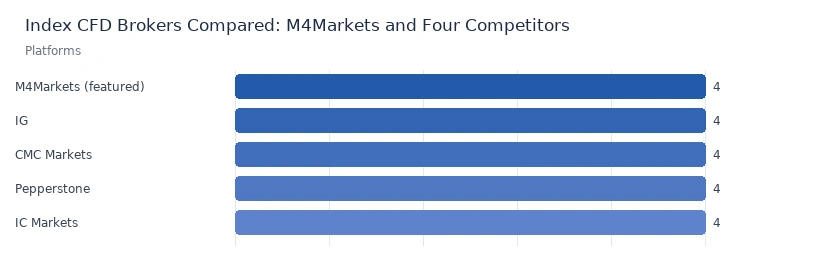
| M4Markets (featured) | From $5 (varies by entity) | — | Up to 1:1000 on offshore entities; lower caps where local rules apply | FSC Mauritius (offshore); other entities vary by region | MT4, MT5 |
| IG | — | From 0.6 pips | 1:30 retail cap on major FX (EU/UK/AU); index CFDs capped lower | FCA, ASIC, BaFin and others, by entity | IG web and mobile platform, MT4, ProRealTime |
| CMC Markets | — | From 0.7 pips | 1:30 retail cap on major FX (EU/UK/AU); index CFDs capped lower | FCA, ASIC, BaFin and others, by entity | Next Generation platform, MT4, mobile app |
| Pepperstone | — | Raw pricing plus commission (Razor account) | 1:30 retail cap in EU/UK/AU; higher on offshore entities | ASIC, FCA, CySEC, DFSA, BaFin and others, by entity | MT4, MT5, cTrader, TradingView |
| IC Markets | $200 | From 0.0 pips (Raw account, plus commission) | 1:30 retail cap in regulated regions; up to 1:500 on offshore entity | ASIC, CySEC, FSA Seychelles | MT4, MT5, cTrader |
How We Compared These CFD Brokers
We chose five brokers that offer index CFDs and are widely discussed by retail traders. We ordered them to show M4Markets first as the featured brand, not because it ranks highest. M4Markets is the site's own affiliated brand, so we let stated facts carry the comparison and note where a competitor is stronger on a criterion.
- Regulation and entity structure: which regulators supervise the entity serving each region, and whether the licence is Tier-1 or offshore.
- Cost transparency: minimum deposit, EUR/USD spread as a common benchmark, and commission structure.
- Leverage and protection: maximum leverage and regional caps, including index CFD limits and negative-balance protection.
- Platforms and tools: platform choice, charting and mobile access relevant to index trading.
- Account range and track record: available account types and years in operation.
Broker Review Details
Each review below presents publicly stated information as we compiled it. Please verify details on the broker's own documents, since entities, licences and pricing change and differ by country.
1. M4Markets — Low entry barrier, offshore-led regulatory profile
M4Markets is the featured and affiliated brand in this article. It was founded in 2015 and offers CFDs on forex, indices, commodities, shares and other markets through MetaTrader platforms. It markets a low minimum deposit and several account types. Which legal entity serves you depends on your country of residence, so check the licence and client agreement for that entity.
| Founded | Regulation | Min Deposit | Spread | Leverage | Platforms |
|---|---|---|---|---|---|
| 2015 | FSC Mauritius (offshore); other entities vary by region | From $5 (varies by entity) | — | Up to 1:1000 on offshore entities; lower where local caps apply | MT4, MT5 |
Pros
- A very low stated minimum deposit makes it accessible for small test accounts.
- MT4 and MT5 give access to familiar charting, indicators and automation tools.
- Several account types let you compare pricing models, including index CFD exposure.
Cons
- Genuine limitation: the main entity is regulated offshore rather than by a Tier-1 regulator, and offshore oversight is not equivalent to Tier-1 protection. Investor safeguards, compensation schemes and leverage rules may differ from those of the FCA or ASIC.
- It is the featured brand here, so you should weigh our presentation accordingly and read the broker's documents yourself.
Best for: traders outside heavily restricted jurisdictions who want a low entry deposit and MetaTrader access, and who accept the offshore-regulation trade-off.
2. IG — Long-established, Tier-1 regulated
IG was founded in 1974, and its parent company is listed on the London Stock Exchange. It is a long-standing provider of index CFDs and spread bets and serves clients through regulated entities in several regions. Its proprietary platform is the main offering, with MT4 and ProRealTime also available. On regulatory standing and track record, IG is objectively stronger than M4Markets.
| Founded | Regulation | Min Deposit | Spread | Leverage | Platforms |
|---|---|---|---|---|---|
| 1974 | FCA, ASIC, BaFin and others, by entity | — | From 0.6 pips on EUR/USD | 1:30 retail cap on major FX in EU/UK/AU; index CFDs capped lower | IG platform, MT4, ProRealTime |
Pros
- Decades of operating history and Tier-1 supervision in several jurisdictions.
- A broad range of index markets and a proprietary platform with built-in analysis tools.
- Retail clients in regulated regions get negative-balance protection and standardised risk disclosures.
Cons
- MT5 is not part of the platform set we compiled.
- Regional leverage caps limit exposure for retail clients, which may not suit those seeking higher leverage.
Best for: traders who prioritise regulatory standing, an established provider and a proprietary platform over very low entry costs.
3. CMC Markets — Strong proprietary platform and index coverage
CMC Markets was founded in 1989 and is listed on the London Stock Exchange. It is known for its Next Generation web platform, with charting, pattern recognition tools and a wide set of index CFD markets. It operates through regulated entities in several regions, and its supervision in major jurisdictions is a clear strength compared with offshore-led brokers.
| Founded | Regulation | Min Deposit | Spread | Leverage | Platforms |
|---|---|---|---|---|---|
| 1989 | FCA, ASIC, BaFin and others, by entity | — | From 0.7 pips on EUR/USD | 1:30 retail cap on major FX in EU/UK/AU; index CFDs capped lower | Next Generation, MT4, mobile app |
Pros
- A long track record and supervision by major regulators.
- An advanced proprietary platform with extensive charting and analysis tools.
- A wide selection of index CFDs alongside other asset classes.
Cons
- MT5 is not part of the platform set we compiled.
- Retail leverage is capped in regulated regions, and some traders may find the proprietary platform less familiar than MetaTrader.
Best for: index traders who value a feature-rich proprietary platform and Tier-1 oversight.
4. Pepperstone — Multi-platform choice with multiple regulators
Pepperstone was founded in 2010 and offers CFDs through several entities supervised by regulators including ASIC, the FCA, CySEC, the DFSA and BaFin. It supports MT4, MT5, cTrader and TradingView and offers Standard and Razor accounts. Pepperstone has a wider platform choice than most brokers in this comparison, including M4Markets.
| Founded | Regulation | Min Deposit | Spread | Leverage | Platforms |
|---|---|---|---|---|---|
| 2010 | ASIC, FCA, CySEC, DFSA, BaFin and others, by entity | — | Raw pricing plus commission (Razor) | 1:30 retail cap in EU/UK/AU; higher on offshore entities | MT4, MT5, cTrader, TradingView |
Pros
- Several Tier-1 and other regulators supervise different entities.
- It supports MT4, MT5, cTrader and TradingView.
- A commission-based Razor account suits traders who want to separate spread from fees.
Cons
- Commission-plus-spread pricing makes cost comparisons across brokers more involved.
- Higher leverage is tied to offshore entities, which carry different protections from regulated ones.
Best for: traders who want platform flexibility and a broker supervised by several recognised regulators.
5. IC Markets — Raw-spread pricing across MetaTrader and cTrader
IC Markets was founded in 2007 and is associated with raw-spread, commission-based accounts. It serves clients through entities supervised by ASIC, CySEC and the Seychelles FSA, and it supports MT4, MT5 and cTrader. Its stated minimum deposit is higher than M4Markets', but its regulatory mix includes Tier-1 supervision for some regions.
| Founded | Regulation | Min Deposit | Spread | Leverage | Platforms |
|---|---|---|---|---|---|
| 2007 | ASIC, CySEC, FSA Seychelles | $200 | From 0.0 pips (Raw, plus commission) | 1:30 retail cap in regulated regions; up to 1:500 on offshore entity | MT4, MT5, cTrader |
Pros
- Raw pricing with commissions gives transparent separation of spread and fees.
- MT4, MT5 and cTrader support a range of trading and automation styles.
- ASIC and CySEC supervision applies to some entities.
Cons
- A $200 minimum deposit is higher than some competitors.
- Higher leverage and weaker protections apply under the offshore entity, so check which entity you would be on.
Best for: cost-conscious traders who prefer raw pricing and a choice of MetaTrader or cTrader platforms.
How to Choose a CFD Broker
Start with the legal entity, not the brand name. Brokers often operate several companies, and the one that accepts you depends on where you live. Check the licence number on the regulator's own register, and understand whether the regulator is Tier-1 or offshore. Regulation does not remove market risk. It sets conduct rules and, in some cases, compensation arrangements.
Next, consider costs beyond headline spreads. For index CFDs, compare typical spreads on the specific index you care about, commissions, overnight financing charges and any inactivity or withdrawal fees. EUR/USD spread is a convenient benchmark, but it may not reflect index pricing.
Review leverage and protection. In the EU, UK and Australia, retail leverage on major equity indices is capped at 1:20, and negative-balance protection applies. Offshore entities may offer much higher leverage, which magnifies losses as well as gains.
Finally, check platform fit and support. Try a demo account to test execution, charting and mobile usability. Confirm the index markets, trading hours and contract sizes you need. Read the risk disclosure, client agreement and order execution policy before depositing. Only use money you can afford to lose, and consider independent advice if you are unsure whether CFDs are right for you.
Frequently Asked Questions
Which is the best CFD broker for indices?
There is no single answer. This is a featured brand comparison, and M4Markets is the affiliated brand. We compared five brokers on regulation, costs, leverage, platforms and track record. IG and CMC Markets are stronger on regulatory standing, Pepperstone on platform choice, and M4Markets on stated minimum deposit. Your best fit depends on your region and needs.
Are index CFDs less risky than other CFDs?
No. Index CFDs are leveraged products, so small price moves can cause large gains or losses. Indices can gap on economic news or overnight, and stop-loss orders may not fill at the expected price. Leveraged trading carries a high level of risk, and losses can exceed your initial deposit where negative-balance protection does not apply.
Does regulation make a CFD broker safe?
No. Regulation sets standards for conduct, capital and client money handling, but it does not protect you from trading losses. Tier-1 regulators generally impose stricter rules than offshore ones. Always confirm which entity you would contract with and what protections, such as compensation schemes or leverage limits, apply in your country.
Can I use these brokers if I live in the United States?
Retail CFDs are not available to US retail clients, so this comparison is not aimed at that audience. Residents of the EU, UK and Australia face leverage caps and mandatory negative-balance protection for retail accounts. Eligibility and product availability vary by region, so check the broker's terms for your country.
Weighing Up Your Options Before You Open an Account
Comparing brokers helps narrow the field, but it cannot make a CFD suitable for you. Tier-1 regulated providers such as IG and CMC Markets offer stronger oversight, while M4Markets lowers the entry barrier with an offshore-led profile. Whichever you consider, verify the entity, fees and protections yourself.
CFDs are complex, high-risk leveraged products, and a high percentage of retail accounts lose money. Past performance does not guarantee future results. This article is a featured brand comparison, not independent financial advice; eligibility and product availability vary by region.