VidaMarkets (vidamarkets.com) is the featured CFD broker in this comparison of five providers for scalping, set alongside IC Markets, Pepperstone, FP Markets and Exness. Disclosure: VidaMarkets is the featured, affiliated brand of this site, and it is included for context next to its competitors. The guide is written for readers who want to understand how brokers differ on spreads, commissions, execution conditions, platforms and regulation. Each broker is assessed against the editorial criteria below, and any figure we could not confirm is shown as "—". CFDs are complex, high-risk leveraged products, and a high percentage of retail accounts lose money.
Quick Comparison Table
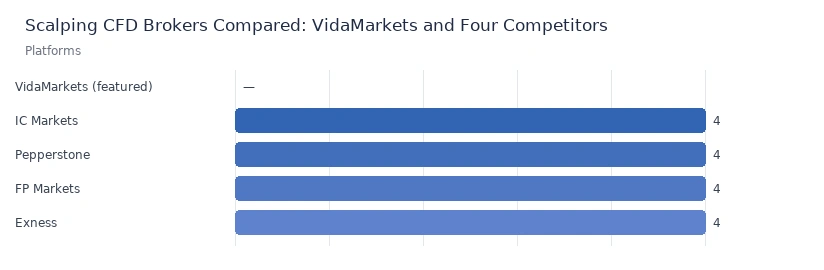
| Broker | Min Deposit | EUR/USD Spread | Max Leverage | Regulation | Platforms |
|---|---|---|---|---|---|
| VidaMarkets (featured) | — | — | — | — (verify entity and licence by region) | — |
| IC Markets | — | — | 30:1 retail cap under ASIC/CySEC rules; other entities vary | ASIC, CySEC; offshore entity also listed | MetaTrader 4, MetaTrader 5, cTrader |
| Pepperstone | — | — | 30:1 retail cap under FCA/ASIC/CySEC rules; other entities vary | FCA, ASIC, CySEC, BaFin, DFSA and others | MetaTrader 4, MetaTrader 5, cTrader, TradingView |
| FP Markets | — | — | 30:1 retail cap under ASIC/CySEC rules; other entities vary | ASIC, CySEC; offshore entity also listed | MetaTrader 4, MetaTrader 5, cTrader, WebTrader |
| Exness | — | — | 30:1 retail cap under FCA/CySEC rules; other entities vary | FCA, CySEC, FSCA; offshore entities also listed | MetaTrader 4, MetaTrader 5, Exness Terminal |
Minimum deposits and spreads change by entity, account type and time, so we have not quoted figures we could not confirm. Check each broker's current legal documents and pricing pages before comparing numbers.
How We Compared These CFD Brokers
This comparison ranks nothing as an objective winner. We looked at the same factual attributes for each provider, using publicly stated information as we understand it, and we say where a competitor is stronger on a criterion. VidaMarkets is the featured brand and is affiliated with this site, so it appears first in the table and the review order. That placement is a format choice, not a verdict on quality.
- Regulation and entity structure: which regulators supervise which entity, and whether offshore entities are involved.
- Pricing transparency: how clearly spreads, commissions and swap costs are published, which matters most for scalping.
- Leverage and regional caps: maximum leverage and the retail limits that apply in the UK, EU and Australia.
- Platforms and execution tools: the trading platforms offered and the order types and tools they support.
- Account structure and access: account types, minimum deposit and the clarity of the terms.
Broker Review Details
1. VidaMarkets — featured brand with data that needs checking
VidaMarkets presents itself as an online CFD provider with an English-language website at vidamarkets.com. It is the featured and affiliated brand of this article. Most of the comparison fields for it, such as founding year, minimum deposit and EUR/USD spread, could not be confirmed for this guide, so they appear as "—". That is not a negative finding. It means a reader should verify the contracting entity, licence and conditions for their own region before anything else. For scalping, the pricing and execution terms matter most.
| Founded | Regulation | Min Deposit | Spread | Leverage | Platforms |
|---|---|---|---|---|---|
| — | — (verify by region) | — | — | — | — |
Pros
- Focuses on CFD products rather than a broad range of unrelated services.
- Offers an English-language site where legal documents and account terms can be reviewed before funding.
- Its featured status here means the comparison fields can be checked directly against its own disclosures.
Cons
- Limitation: key data points (licences by region, spreads, minimum deposit, platforms) could not be confirmed here, which makes a like-for-like comparison with established competitors harder. This is the featured brand, and the gap is a limit of this article.
- A track record and published pricing history comparable to long-established rivals could not be established.
Best for: readers who want to examine a newer or less documented provider and are prepared to verify the entity, regulation and scalping terms themselves.
2. IC Markets — documented raw pricing structure
IC Markets was founded in 2007 and is widely associated with raw-spread, commission-based accounts, a structure often favoured by people who trade frequently. It supports MetaTrader 4, MetaTrader 5 and cTrader. On the criteria used here, it is stronger than VidaMarkets on documented history and platform range. Its group includes entities supervised by ASIC and CySEC, as well as an offshore entity. The offshore entity should not be regarded as equivalent to Tier-1 supervision, and the protections you receive depend on which entity you are onboarded with.
| Founded | Regulation | Min Deposit | Spread | Leverage | Platforms |
|---|---|---|---|---|---|
| 2007 | ASIC, CySEC; offshore entity also listed | — | — | 30:1 retail cap under ASIC/CySEC rules; other entities vary | MetaTrader 4, MetaTrader 5, cTrader |
Pros
- Long operating history compared with newer providers.
- Three platform choices, including cTrader, which some active traders prefer for its order handling.
- Commission-based raw account structure that makes the cost per trade easy to calculate.
Cons
- Commissions are charged on top of spreads, so total cost has to be calculated rather than read from the spread alone.
- Protections and leverage differ across entities, so the offshore route carries a different risk profile.
Best for: active traders who want a documented raw-pricing model and a choice of platforms.
3. Pepperstone — broad regulatory footprint
Pepperstone was founded in 2010 and operates under a wide spread of regulators, including the FCA, ASIC, CySEC, BaFin and the DFSA. On regulatory breadth, it is stronger than most competitors in this list. Platform choice is also wide: MetaTrader 4, MetaTrader 5, cTrader and TradingView. Like the others, it offers both standard and commission-based pricing, and the right account depends on how often you trade and at what size. Retail clients under FCA, ASIC and CySEC rules face the 30:1 leverage cap on major forex pairs.
| Founded | Regulation | Min Deposit | Spread | Leverage | Platforms |
|---|---|---|---|---|---|
| 2010 | FCA, ASIC, CySEC, BaFin, DFSA and others | — | — | 30:1 retail cap under FCA/ASIC/CySEC rules; other entities vary | MetaTrader 4, MetaTrader 5, cTrader, TradingView |
Pros
- Supervision by several well-known regulators across different regions.
- TradingView integration alongside the MetaTrader and cTrader platforms.
- Account options that separate commission-based and spread-only pricing.
Cons
- Retail leverage is capped in most regulated regions, which limits position sizing for those clients.
- Total trading cost depends on account type and commission, so a headline spread alone is not enough to compare it.
Best for: traders who put regulatory coverage and platform variety first.
4. FP Markets — platform variety and an older brand
FP Markets was founded in 2005, which makes it the oldest brand in this comparison. It is supervised by ASIC and CySEC, and also operates an offshore entity. It offers MetaTrader 4, MetaTrader 5, cTrader and a web-based platform, and it also supports raw-spread accounts. For scalping, the relevant questions are how the broker handles order execution, what its terms say about trading frequency and stop levels, and which entity you would be onboarded with. Those terms should be read in the legal documents rather than assumed.
| Founded | Regulation | Min Deposit | Spread | Leverage | Platforms |
|---|---|---|---|---|---|
| 2005 | ASIC, CySEC; offshore entity also listed | — | — | 30:1 retail cap under ASIC/CySEC rules; other entities vary | MetaTrader 4, MetaTrader 5, cTrader, WebTrader |
Pros
- Longest operating history among the five brands.
- Multiple platform options, including a browser-based one.
- Raw-spread account type suited to cost-conscious active trading.
Cons
- Account terms and protections differ between its regulated and offshore entities.
- Commission and spread have to be combined to estimate real cost, and published figures vary by account.
Best for: readers who value a long-standing brand and a wide choice of platforms.
5. Exness — high-volume brand with entity differences
Exness was founded in 2008 and holds licences through entities supervised by the FCA, CySEC and the FSCA, alongside offshore entities. It supports MetaTrader 4 and MetaTrader 5, plus its own terminal. It is widely known for the scale of its retail business. As with every provider here, the protections, leverage and products available depend on the entity serving you. A client in a strictly regulated region will see different terms than a client onboarded elsewhere. That difference should be checked before relying on any figure quoted in a review.
| Founded | Regulation | Min Deposit | Spread | Leverage | Platforms |
|---|---|---|---|---|---|
| 2008 | FCA, CySEC, FSCA; offshore entities also listed | — | — | 30:1 retail cap under FCA/CySEC rules; other entities vary | MetaTrader 4, MetaTrader 5, Exness Terminal |
Pros
- Several account types for different trading styles.
- Supervision by recognised regulators for some of its entities.
- Proprietary terminal in addition to the MetaTrader platforms.
Cons
- Terms vary significantly between entities, so quoted conditions may not apply to every client.
- No cTrader support, which may matter to traders who prefer that platform.
Best for: traders who want a large, established provider and are comfortable checking entity-specific terms.
How to Choose a CFD Broker
Start with the entity, not the brand. Find the legal name of the company that would hold your account, then look it up on the relevant regulator's public register. Regulation can add safeguards such as client money segregation and complaint routes, but it does not remove market risk or guarantee any outcome. Be cautious with offshore entities, which are not equivalent to Tier-1 supervision.
Next, look at the full cost of trading. For frequent short-term activity, a spread, a commission and swap charges all matter, and a low headline spread can be offset by commission. Read the terms for any restrictions on trading frequency, minimum stop distances or order handling, since these vary and can affect how an account is actually used.
Check regional rules. Retail clients in the UK, EU and Australia face leverage caps, commonly 30:1 on major forex pairs, and negative-balance protection applies in those regions. Retail CFDs are not available to US retail clients, so this comparison is not aimed at that audience.
Finally, test the platform on a demo account, review the withdrawal terms, and confirm the support channels. Only risk money you can afford to lose.
FAQ
Which CFD brokers are included in this scalping comparison?
This is a featured brand comparison of five providers: VidaMarkets, IC Markets, Pepperstone, FP Markets and Exness. VidaMarkets is the affiliated brand of this site and is listed first. The criteria are regulation, pricing transparency, leverage and regional caps, platforms, and account access. Where data could not be confirmed it is shown as "—", and competitors are noted as stronger where the information supports it.
Does regulation make a CFD broker safe?
No. Regulation can provide safeguards such as segregated client funds, complaint procedures and conduct rules, but it does not remove market risk. Leveraged trading carries a high level of risk, and losses can exceed your initial deposit where negative-balance protection does not apply. Check which entity serves you and which regulator supervises it.
What costs matter most for scalping?
For frequent short-term trading, the combined cost of spread, commission and any swap or financing charge matters more than any single number. Slippage and order execution quality also affect results, but they vary by market conditions. Compare costs on the specific account type and entity you would use, not on a marketing headline.
Are CFDs available to everyone?
No. Eligibility and product availability vary by region. Retail CFDs are not available to US retail clients, and the UK, EU and Australia apply leverage caps and negative-balance protection for retail accounts. Confirm what your local rules allow before opening an account.
Final Considerations Before Opening an Account
A comparison like this can help narrow a shortlist, but it cannot replace reading each broker's own legal documents, pricing schedule and risk warnings. Several established competitors here have longer track records and more documented data than the featured brand, and readers should weigh that fairly. Past performance does not guarantee future results. This article is a featured brand comparison, not independent financial advice; eligibility and product availability vary by region. CFDs are complex, high-risk leveraged products, and a high percentage of retail accounts lose money.